
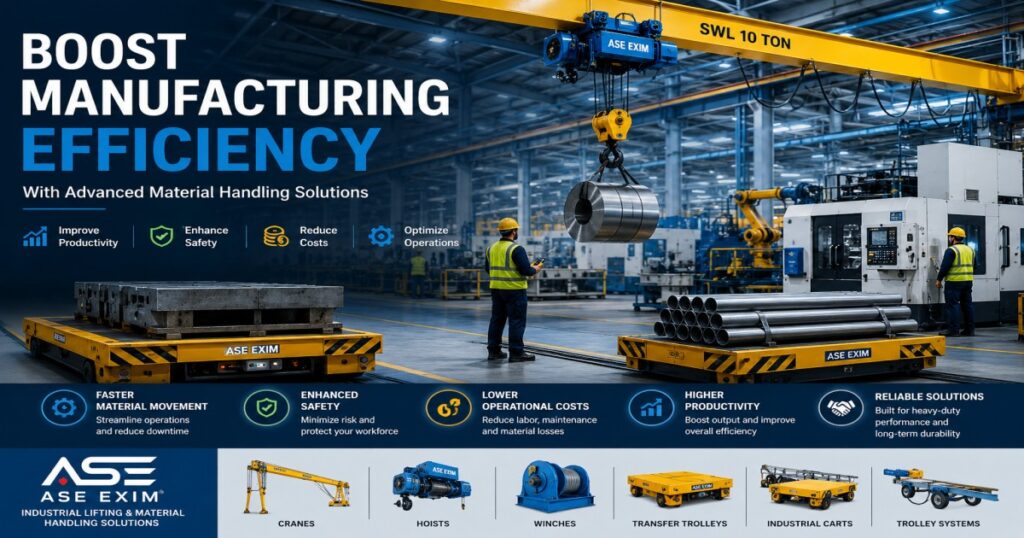
Boost Manufacturing Efficiency. In today’s competitive manufacturing environment, efficiency is a key factor that determines productivity, profitability, and customer satisfaction. As industries continue to expand and production demands increase, businesses are adopting advanced material handling equipment to streamline operations and reduce downtime.
From cranes and hoists to transfer trolleys and industrial carts, material handling systems play a crucial role in ensuring the smooth movement of materials throughout the production process.
What is Material Handling Equipment?
Material handling equipment refers to machines and systems used to lift, transport, store, and control materials in manufacturing facilities, warehouses, and industrial plants. These solutions help businesses move heavy loads safely and efficiently while minimising manual effort.
Common examples include:
- Cranes
- Hoists
- Electric Winches
- Transfer Trolleys
- Transfer Carts
- Industrial Trolley Systems
Enhancing Productivity Through Faster Material Movement
One of the biggest advantages of material handling equipment is improved productivity. Efficient movement of raw materials, components, and finished products reduces delays and keeps production lines running smoothly.
Modern material handling solutions help manufacturers:
- Minimise unnecessary material movement
- Reduce loading and unloading time
- Improve workflow efficiency
- Increase production output
- Optimize operational performance
By reducing bottlenecks, manufacturers can complete projects faster and improve overall plant efficiency.
Improving Workplace Safety
Manual handling of heavy materials can lead to workplace injuries, product damage, and costly downtime. Material handling equipment provides a safer alternative by reducing physical strain on workers and improving load control.
Benefits include:
- Reduced risk of accidents
- Better load stability
- Lower employee fatigue
- Improved compliance with safety standards
- Enhanced workplace safety
Investing in reliable equipment helps companies create a safer and more productive working environment.
Reducing Operational Costs
Efficient material handling systems help businesses lower operating expenses by reducing labour requirements and minimising material losses. Proper handling also decreases equipment wear and improves resource utilisation.
Advantages include:
- Reduced manpower requirements
- Lower maintenance costs
- Decreased product damage
- Improved inventory management
- Increased return on investment
These savings contribute directly to improved profitability and long-term business growth.
Supporting Heavy Industrial Applications
Industries such as manufacturing, construction, infrastructure, automotive, warehousing, logistics, and power generation depend heavily on reliable material handling equipment.
Applications include:
- Moving raw materials
- Handling heavy machinery components
- Loading and unloading operations
- Warehouse transportation
- Assembly line support
- Industrial storage solutions
Customised material handling systems ensure that businesses can meet industry-specific requirements efficiently.
Importance of Choosing the Right Equipment
Selecting the right material handling solution depends on several factors:
- Load capacity requirements
- Working environment
- Frequency of operation
- Space availability
- Safety standards
- Future expansion needs
Partnering with experienced manufacturers ensures access to reliable and customised solutions that improve productivity and operational efficiency.
The Role of Automation in Material Handling
Modern manufacturing facilities are increasingly adopting automated material handling solutions to improve productivity and accuracy. Automated systems help streamline workflows, reduce manual intervention, and ensure consistent operations.
Benefits of automation include:
- Faster material transportation
- Reduced operational downtime
- Improved production efficiency
- Better inventory management
- Enhanced workplace safety
By integrating advanced material handling equipment with automated processes, manufacturers can achieve higher productivity while maintaining quality standards.
Importance of Regular Maintenance
Regular maintenance plays a vital role in ensuring the long-term performance and reliability of material handling equipment. Proper inspection and preventive maintenance help reduce unexpected breakdowns and improve operational efficiency.
Key maintenance practices include:
- Routine equipment inspections
- Timely replacement of worn components
- Lubrication and servicing of moving parts
- Safety checks and load testing
- Scheduled preventive maintenance programs
Well-maintained equipment not only improves productivity but also extends service life and reduces overall operating costs.
Future of Material Handling Solutions
As industries continue to evolve, material handling equipment is becoming smarter and more efficient. Innovations such as automation, IoT-enabled monitoring, and energy-efficient systems are transforming manufacturing operations worldwide.
Businesses that invest in modern material handling solutions gain a competitive advantage through improved productivity, reduced costs, and enhanced operational performance. Choosing reliable equipment and partnering with experienced manufacturers can help organisations achieve sustainable growth and long-term success.
Conclusion
Material handling equipment has become an essential part of modern manufacturing. By improving workflow, enhancing safety, reducing costs, and increasing productivity, these systems help businesses achieve greater operational efficiency and maintain a competitive advantage.
As manufacturing industries continue to evolve, investing in high-quality material handling solutions is not just an option—it is a necessity for sustainable growth and long-term success.
Contact Us
Address
Kolhapur, Maharashtra, India
Phone Number
+91 8975167474
+91 9284057977
Email Address
info@aseexim.com